“But when the fullness of time had come, God sent forth his Son, born of woman, born under the law, to redeem those who were under the law, so that we might receive adoption as sons. And because you are sons, God has sent the Spirit of his Son into our hearts crying “Abba! Father!” So you are no longer a slave but a son, and if a son, then an heir through God” (Galatians 4-6).
For a parent, there is nothing better than hearing your child say “Mama” or “Daddy” for the first time, and there is nothing more precious than that title to a parent.
Romans 8:15-16 says that it’s the Spirit of adoption that allows us to say “Abba! Father!”
The irony is that Jesus himself was adopted, and because of his coming, we can be adopted into the Family of God. As adopted sons and daughters we can call God, “Father.”
“In Bethlehem of Judea, for so it is written by the prophet:
“’And you, O Bethlehem, in the land of Judah,
are by no means least among the ruler of Judah;
for from you shall come a ruler
who will shepherd my people Israel.’”
(Matthew 2:6, cited from Mic. 5:2)
The wise men saw the star. They knew the prophesy that said the Messiah would be born in Bethlehem, and they began the journey to behold him. When they came to Herod, they asked, “Where is he who has been born king of the Jews? For we saw his star when it rose and have come to worship him.” They came, bringing their worship with them. “And going into the house, they saw the child with Mary his mother, and they fell down and worshipped him” (Matt. 2:11). They offered the proper response to what they were witness to – the Promised One before their eyes.
“Then, opening their treasure, they offered him gifts, gold and frankincense and myrrh.” The gifts they brought foreshadowed what lay ahead. Gold denoted his Kingship. Frankincense, an incense used by the priests, indicated he would be a Priest greater than any other. Myrrh, a spice used in burial, foretold his death and the suffering to come.
“The Lord is God, and he has made his light to shine upon us. Bind the festal sacrifice with cords, up to the horns of the altar!” Psalm 118:27
Psalm 118 is rich in prophetic implications. Verse 22 says, “The stone that the builders rejected has become the cornerstone.” A cornerstone of a building is placed before anything else, and is the thing around which the whole structure is built. Jesus is the Cornerstone of the symbolic building that is his Church. We are the “living stones,” as Peter says, who are “being built up as a spiritual house, to be a holy priesthood” (1 Pet. 2:5).
In Jesus’s triumphal entry into Jerusalem, before the tide of public opinion turned against him, the people cried out in adoration, “Blessed is he who comes in the name of the Lord” (Psalm 118:26). The Psalm then goes on to say that God has “made his light to shine upon us.”
The light had come, but a sacrifice was still required, a “festal sacrifice” as talked about in verse 27. The sacrifice that was to be “bound and brought to the altar” was Jesus. He is the Passover Lamb, the perfect sacrifice.
“Have this mind among yourselves, which is yours in Christ Jesus, who, though he was in the form of God, did not count equality with God a thing to be grasped, but emptied himself, by taking the form of a servant, being born in the likeness of men.” Philippians 2:5-7
St. Irenaeus, an early Church Father said, “Through his transcendent love, our Lord Jesus Christ became what we are, that he might make us to be what he is.”
Jesus left the splendor of Heaven, condescending to our level. Even though he was with God from the beginning, he did not cling to his position. He became one of us, “taking the form of a servant” (v.7). He humbled himself by becoming “obedient to the point of death, even death on a cross” (v.8).
We who are in Christ are to have this same mindset. 1 Cor. 2:16 says, “But we have the mind of Christ.” We are to have his mind and imitate his life.
There Was a Life
There was a life, a life come to show us the way
There was a life that was the word become flesh and blood
There was a life that pierced the darkness of the world
“I will put my laws in their hearts and write them on their minds.”
Hebrews 10:16
Covenantal agreements were a part of Jewish life. These formal agreements could be agreements between God and people, or between people themselves. But one important feature of a covenant was that it had a relational aspect.
In Hebrews 10, the Apostle Paul quotes Jeremiah 31:31, in which God makes a promise of the future to Israel, “Behold, the days are coming, declares the Lord, when I will make a new covenant with the house of Israel and the house of Judah.”
He goes on to say that this covenant will not be like the one He made with their fathers when he brought them out of Egypt. He says in verses 33-34, “For this is the covenant that I will make with the house of Israel after those days, declares the Lord; I will put my law within them, and I will write it on their hearts. And I will be their God, and they shall be my people. And no longer shall each one teach his neighbor and each his brother saying, ‘Know the Lord,’ for they shall all know me, from the least of them to the greatest, declares the Lord. For I will forgive their iniquity, and I will remember their sin no more.”
Paul makes the case in Hebrews that the old sacrificial system can never remove sins, and “we have been sanctified through the offering of the body of Jesus Christ once for all” (v.10).
A new covenant through the blood of Jesus. Forgiveness of sin because of his sacrifice, offered for everyone.
“The Word became flesh and dwelt among us” John 1:14.
The Word.
He is the Word incarnate, the Logos, and his name, the name of Jesus, is above every other name. In the beginning, God spoke the Word, and everything came to be.
“In the Beginning was the Word, and the Word was with God, and Word was God. He was in the beginning with God. All things were made through him, and without him was not anything made that was made. In him was life, and the life was the light of men. The light shines in the darkness, and the darkness has not overcome it” (John 1:1-5).
The beginning is long past, and the end is not yet fully realized. We are in the middle of our story, the story of the ages, the greatest ever told. The crimson thread of redemption runs from Genesis to revelation, the thread of our Savior’s blood and sacrifice.
The Messiah has come. Hope is here, and hope is coming again. And when he comes again, hope will be fully realized. The Scripture tells us, “For all the promises of God find their yes in Him” (2 Corinthians 1:20). All of the promises are fulfilled in his life, death, and resurrection.
In Ephesians 3:8-9, the Apostle Paul writes of the “unsearchable riches of Christ,” to “bring to light for everyone what is the plan of the mystery hidden for ages in God, who created all things.” Jesus is the mystery being revealed – He is the realization of all the prophesies of old.
Jesus confirmed that He was sent by God when He prayed, “This is eternal life; that they know you, the only true God, and Jesus Christ whom you have sent” (John 17:3). Jesus says in verse 5 that He existed eternally with the Father, before the world came into existence. He continues praying for His disciples, praying that they will be one, even as He and the Father are one. He says, “I kept them in your name, which you have given me. I have guarded them, and not one of them has been lost except the son of destruction that the Scripture might be fulfilled.”
A baby changes everything. How many times have you heard that phrase? And if you are a parent, you know it’s true. The most significant and life changing days are when babies are born. Few are the women for whom motherhood does not cause a seismic shift in priorities and understanding. The birth of a child changes dads also, to be sure, but the mother is the one whose body has been linked with this new little person for nine months, creating a bond that can never really be broken. Extended family and friends help to welcome babies into the world as well, all celebrating the joy that has come.
New life. New hope. New promise. Is it any wonder that God chose to come into the world this way? He can do anything he wants, any way He wants – He can rearrange molecules and reach into time and space and touch the smallest of things. He could have come into the world in some other way, or to a family of prominence or wealth. But He came as a small vulnerable baby to the humble, to show us how to be humble. He came in the lowliest of places, among hay and cattle, the Bread of Life, to be laid in a feeding trough. The symbolism is rich – “This is my body, given for you.”
When new life comes and we hear a baby’s first cry, there’s relief and joy. But the cry that split the darkness that Holy night was like no other.
I’ve heard it said, “Home is where your mother is,” and I do think it’s true. People usually refer to the place their parents are as “home.” When you don’t have your parents anymore and you are essentially an orphan, you can feel somewhat unmoored, like some stability that you had is gone, and it can feel a bit lonely.
But we have to remember God is our ultimate “home.” Jesus says in John 14:18 that he will “not leave us as orphans.” Beautifully, we have a home with him, and he makes his home with us.
So the reality is more accurately, “Home is where your Father is.”
In John 14:3, Jesus tells us that he is going to prepare a place for us. The meaning of this statement would have been understood in that day, as a groom typically prepared a room for his bride, often built onto his father’s house. Jesus is preparing rooms for his Bride, the Church.
We have the promise of a home with him, but he also wants to make a home with us. In verse 23 Jesus says, “If anyone loves me, he will keep my word, and my Father will love him, and we will come to him, and make our home with him.”
But would he feel at home in every room? Is he welcome? There are some physical rooms in my house I would not want people to go into, because they are disorganized and full of clutter that should have been tossed out years ago.
Are there spaces in our lives where God the Father, the Son, and the Holy Spirit could not enter? Are our hearts open, uncluttered?
This season, have we prepared the rooms of our hearts just as we take care to prepare our homes, and the gifts, and the food?
Maybe it’s time to take out the trash, clean up the clutter, dust the crevices that may not have had attention in a while, and prepare him room.
“Do not fear, only believe.” Jesus said these words after He heard that the little girl He was on the way to heal, had died. I wonder if in that statement, He was reiterating the words of the Psalm that said, “Though I walk through the valley of the shadow of death, I will fear no evil, for you are with me.” – The psalm that talks about God being our Shepherd, being with us even when we are in the deep dark valley, even in death.
On the way, Jesus had already been interrupted by a woman also in need of healing. It might have appeared that the delay had prevented him from getting to Jairus’s daughter in time. “Why trouble the Teacher any further?” the one delivering the news asked.
But Jesus went into the home where the mourners were already gathered, wailing loudly because death had come. He told them the girl was not dead but merely sleeping. When they laughed, He put them out of the house and turned His attention to the girl.
The Scripture says He took her by the hand and said, “Little girl, I say to you, arise.” Most versions say, “little girl,” but the Aramaic phrase, “Talitha Cumi,” is a term of endearment that can actually mean “little lamb.” This has even richer meaning when we consider that He is the Good Shepherd. We are His sheep, and we know His voice (John 10).
The Good Shepherd called her from death by calling her “little lamb.” She knew His voice and “got up and began walking.”
Restored. Whole.
Still today, He calls us from death to life and saves all who call upon Him.
He restores our souls.
He leads us beside still waters and gives us rest.
We live in a universe of order. From human bodies to heavenly bodies, things don’t just arrange themselves. When you move toward increased complexity, things are not more random but more ordered. If we threw the letters of the alphabet up in the air and let them fall, they would not likely come down in any order that made sense – I doubt they would even form one word as they scattered on the floor. But if those same letters are arranged purposely by an author, a designer, they are formed into something beautiful and complex. We then have something meaningful – like Shakespeare, or a poem, or lyrics to a song, which would never be created from the thrown and scattered letters.
Things in random order do not tend toward increasing organization but increasing disorder. An example of this is computer code. A computer needs a “coder” to write a comprehensible program. When Charles Darwin published his book in 1859, he had no idea about DNA, and the complex codes that give rise to human beings and animals. Since the human genome has been mapped, we understand how the arrangement of DNA is like computer coding in many ways.
Darwin always acknowledged there were weaknesses and gaps in his theory, and that is now more evident than ever. Time itself was always the hero of Darwin’s story, as I have heard Stephen Meyer say, however recent data suggest that there has simply not been enough time for the evolutionary changes he supposed, to take place to form all the various species on the earth.
But it seems the atheists and those who hold a certain worldview they feel they must defend, continue to cling to Darwin’s theory like a piece of driftwood in an ocean of evidence to the contrary. The complexity in living things, the systems that must work together and the enzymes that must be present to catalyze chemical reactions within the body all cry out that there must be a Designer behind it all.
It seems to me the atheists and doubters need one miracle to be true – the beginning just happened – without a Creator. However, the Christian worldview explains creation, explains it all. It not only explains how life came to be, but how we can have peace. Peace with God, peace with each other, and peace eternally.
Science, with all its helpfulness, can never explain everything about the world, and is not meant to. It can’t measure love, can’t define meaning, can’t define truth, and can’t bring peace to the world. A “double-blind study with a control group” cannot answer life’s deepest questions.
True science is always changing, always evaluating the evidence and coming to conclusions based on that current evidence. It’s ironic to me when someone says, “I trust the science,” when to be true to itself, “science” must admit that it might be wrong and must be open to further investigation! Think for a moment about how many times scientists have been wrong about things and told us things were not harmful when they actually were. Too many times to name here. What they tell us with such conviction today, might not be “true” 5 years from now, as more evidence comes to light.
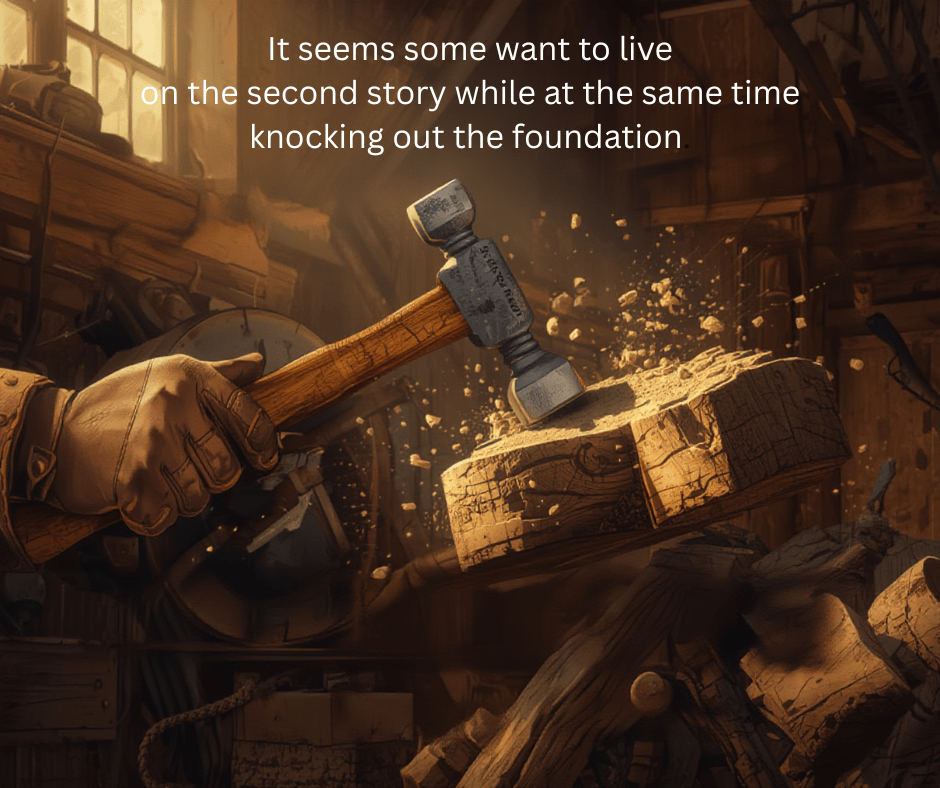
As for me, I’ll trust in the Word of God, the foundation that has sustained so many for thousands of years, the foundation that has answers for life’s deepest questions, and the foundation that cannot fail. I’ll trust in the Kingdom that is unshakable and the One who rules it all.