“…a better hope is introduced, through which we draw near to God” (Hebrews 7:19)
Jesus is better – immeasurably better than everything that came before, the “guarantor of a better covenant” (Heb. 7:22), able to save to the uttermost those who draw near to God through him (Hebrews 7:25).
Blood was an important part of demonstrating a covenantal relationship in biblical times, and the shedding of blood was necessary for the redemption of sins. This would have been a concept that everyone would have understood in that day.
The blood of Abel was shed in the very first murder. God told Cain, “Your brother’s blood cries out to me from the ground.” That blood cried out for vengeance. But Hebrews 12:24 tells us that the blood of Jesus “speaks a better word than the blood of Abel.”
Abel’s blood cried out for revenge.
Jesus’ blood cries out forgiveness.
Abel’s blood cried out for justice.
Jesus’ blood cries out mercy and atonement.
Present tense.
Jesus’ blood still speaks today, to your heart and mine. Once and for all the sacrifice was given. The spotless lamb, slain before the foundation of the world, given for the sins of the whole world.
He is better. His sacrifice, His hope, His power – all better.
Have you ever been in a difficult situation you thought would never end? You felt abandoned, maybe even by God Himself? I have an idea this was how John the Baptist felt when he was in prison, while Jesus still walked the earth. After hearing things about Jesus’ ministry while he was in prison, John sent two of his disciples to ask Jesus if He was the promised one, the Messiah, or if they should still be looking for someone else.
Reading between the lines, I wonder if John’s thought process was something like, “If you are the One, you have the power to do anything, and yet, I’m still here – still in this jail, still waiting for you to DO something!”
Jesus responds to their query with, “Go and tell John what you have seen and heard: the blind receive their sight, the lame walk, lepers are cleansed, and the deaf hear, the dead are raised up, the poor have good news preached to them. And blessed is the one who is not offended by me.” Jesus was doing what he was sent to do; he was God in human skin, doing what God does: healing the sick, resurrecting the dead, delivering good news. Why did he not rescue John from prison? I don’t have the answer to that question, but just because we don’t have all our “why” questions answered, it doesn’t mean God stops being who He is. He may not always do what we want, exactly when we want, but He’s always working to fulfill His purposes in and through us.
That’s all well and good and true, you might say, but I’m still here– in this mess, in this heartbreak, in this hardship.
My Friend, do you know what Jesus wants to say to you?
“I’m Still Here”
I am with you in the mess, in the heartbreak, in the hardship.
“In the world you will have tribulation. But take heart; I have overcome the world” (John 16:33).
He is good.
His promises are true.
His steadfast love endures to all generations.
“And behold I am with you always, to the end of the age” (Matthew 28:20).
Whenever a person encounters Jesus, it changes him or her. All through Scripture we see encounters with people who are willing to give up everything, including their sin, after encountering Messiah. One such person was Zacchaeus. If you are over about 20 years of age, and grew up in church, you probably remember singing the Sunday School song about him (always a fan favorite). This was before the days of children’s areas that look like mini versions of Disneyland; it was a simpler time of butter cookies and apple juice, and felt boards that were the highlight of the lesson.
The song went like this:
Zacchaeus was a wee little man
And a wee little man was he
He climbed up in a sycamore tree
For the Lord he wanted to see
And as the Savior passed that way
He looked up in the tree
And said, Zacchaeus, you come down!
For I’m going to your house today
For I’m going to your house today
As a child, I guess the idea I came away with was that it was really cool to have Jesus come to your house for dinner, and that it was ok to climb a tree, or do whatever you had to do, to be able to see him and get His attention.
As an adult, this still resonates – do whatever you have to do to see Jesus clearly. Make time for Him, make sure you are in the appropriate place and position to be able to see Him.
Luke 19 tells us about Zacchaeus, that he was a “chief tax collector” and was “wealthy.” When Jesus tells him to come down out of the tree, Zacchaeus immediately does what Jesus asks, and welcomes Jesus to come and dine with him. People in the crowd were angry that Jesus was associating with one so reviled. “He has gone to be the guest of a sinner,” they muttered.
But what happens next is remarkable. Zacchaeus says, “Look, Lord! Here and now, I give half of my possessions to the poor, and if I have cheated anybody out of anything, I will pay back four times the amount” (Luke 19:8). When he saw and accepted Jesus for who He was, Zacchaeus saw himself with greater clarity. He immediately responded with obedience that required a turning away from his old ways, from the practice of gouging the people for more than they owed. He also responded with a promise to be generous with his wealth, to give away half of everything he owned. Jesus tells Zacchaeus, “Today, salvation has come to your house.”
When we truly see Jesus and encounter Him, we are never the same; we can’t be. The old has passed away, and the new has come (2 Corinthians 5:17). No matter who you are or where you come from, no matter if you are the most respected person in the community, or feel like an outcast, Jesus wants to come and dine with you.
“Behold, I stand at the door and knock. If anyone hears my voice and opens the door, I will come in to him and eat with him, and he with me” (Revelation 3:20).
I long to see Him ever more clearly, to make my table ready for Him.
I have been watching a humongous building going up in a corridor on the Atlanta Highway, which is now filled with warehouses – I’m talking warehouses which are several hundred thousand feet in scale. I noticed the corner of this soon to be monstrosity as it stood alone, being braced, it appeared, by beams as large as telephone poles. Even though I have known in theory what a cornerstone is, I don’t believe I have ever seen the corner of a cement building at its inception. A cornerstone, also called a foundation stone or setting stone, is the first stone set in the construction of a masonry building, around which all other stones will be set. It determines the position of the entire structure.
As I stared at it, I hoped, for the builder’s sake, that it was straight. Even if it were just a little “off,” the whole structure would be compromised. I couldn’t help but think about the Scripture describing Jesus as the Cornerstone – the chief Cornerstone, on which the church is built (Ephesians 2:20-21). He is the foundation for the church and for our very lives. How many lives are out of whack, crooked and disjointed, because the foundation, meant to orient the rest of the structure of our lives, is missing, or not in the proper place?
Paul describes the foundational characteristic of the nature of Christ in Colossians 1:15-. “He is the image of the invisible God, the firstborn of all creation. For by him all things were created, in heaven and on earth…in him all things hold together.” He holds it all together; it is his very nature. He wants to be the cornerstone of our lives, around which everything else is built.
So I ask today, who or what, is your cornerstone? What are you building your life around – relationships, money, career, amusement? Anything other than the Chief Cornerstone is like building on shifting sand.
May we build well, on the sure foundation that will not fail.
It always happens after the decorations are taken down – you see that one lone ornament hook that somehow missed getting put in its proper place during the hustle and bustle of getting the decorations put away for another year. There it was, lying there sad looking – left behind – a reminder of the celebration gone by. Once attached to a sparkly ornament, but now separated from what gave it purpose. How many lives are like that, I thought- living on the memories of yesterday, left behind, either by people or by circumstances, no longer engaging in life, separated from what gives true purpose.
The new year brings no shortage of resolutions, and opportunities to look at our lives and dream about ways to make them better. But one of the greatest things we can do in 2023 is to connect with that which gives us purpose, that which joins us with something bigger than ourselves. The situation with the Pandemic we have been living through for the last few years seems to have disconnected us in many ways from what is primary – our connection to others, to family, to the local church.
This year, above all else, let’s resolve to plug into those relationships and people that help us fulfill our purpose. Reconnect with your church if you have been away for a while; there are people who are waiting to welcome you with open arms.
1 Corinthians 2:27
-Now you are the body of Christ, and each one of you is a part of it.
What do you have that God can use – that He wants to use? There can be two ways of thinking about the answer to that question which are problematic and probably all too common. You may think that what you have is not enough. On the other hand, you may place a very high value on things you have to give up. So, what you have to offer may seem like nothing – or it may seem like everything.
Like Moses, you might be prone to lay out your excuses to God for why you are ill suited for a particular assignment from Him. If you know about Moses’ story, you know Moses implored God to use Aaron for the job of freeing God’s people. Moses was “slow of speech” and was focused on his inadequacies, but God reminds him that He has made all people as they are for a particular purpose. The Lord said to him, “Who has made man’s mouth? Or who makes him mute or deaf, or seeing or blind? Is it not I, the Lord?” (Exodus 4:11). God can take something the world sees as weak, and use it for His glory. “But God chose the foolish things of the world to shame the wise. He chose the weak things of the world to shame the strong.” (1 Corinthians 1:27). If there is anything I have learned about the character of God, as I look through Scripture and observe the lives of people I know, it’s that He loves to do this. He loves to use the unlikely, the weak, the ordinary, to accomplish the extraordinary.
Also in this passage, God told Moses to throw down the rod he was holding in his hand. Moses did and it became a snake – Moses ran from it, but then picked it up as he was instructed to do. The rod was a very important thing back in those times. Shepherds used their rods to bring correction to sheep, to keep the sheep together, and for protection. Maybe Moses was hesitant to even throw down the rod in the first place. What he was holding in his hand was precious to him. When he does throw it down, it becomes something scary, something that didn’t look like a blessing, that much is sure. In fear he picks it back up and it turns into a rod again. This sign was given so that Moses could perform the wonder in front of Pharoah, that he might see and know God’s power.
Whether you think you don’t have what it takes to accomplish big things for the Kingdom, or whether you’re holding on too tightly to what you have in your hand, what is holding you back from being all that you can be, from doing all that you can do, from truly fulfilling your purpose on earth? Is it fear? Is it doubt? Is it love of money, status, or comfort? He wants it all and can use it all for his glory.
As the old song says, “Give it up, let it go, throw it down.”
“Therefore, as God’s chosen people, holy and dearly loved, clothe yourselves with compassion, kindness, humility, gentleness and patience. Bear with each other and forgive one another if any of you has a grievance against someone. Forgive as the Lord forgave you. And over all these virtues put on love, which binds them all together in perfect unity.” Colossians 3:12-14
When we are wounded, the natural inclination is to seek to wound in return, to retaliate. This is especially true if the person who hurt you is very close to you in some way. We want them to know how much they hurt us, and to feel some of the pain they inflicted on us. But as usual, when we start to feel these things, we find God calling us to a higher standard: “But I (Jesus) say to you, love your enemies, bless them that curse you, do good to them that hate you, and pray for them which despitefully use you.” (Matthew 5:44). Again, when Peter asks, “How often should I forgive my brother -up to 7 times?” Jesus says, “Not seven, but seventy times seven.” (Matthew 18:21-22). In other words, our forgiveness should be limitless. In this I do not mean that people don’t sometimes have issues with one another that need to be brought out in the open and dealt with, but the attitude should still be one of love, forgiveness, and reconciliation.
Jesus conveyed that our relationship to our fellow man is of upmost importance. “So if you are offering your gift at the altar, and there remember that your brother has something against you, leave your gift there before the altar and go. First be reconciled to your brother and then come and offer your gift.” (Matthew 5:23-24)
He desires that our relationships be right with one another before he desires our offerings. Jesus included relationship to others when the Pharisees asked him which was the greatest commandment. “Love the Lord your God… and your neighbor as yourself.” (Matthew 22:37-38)
Because we human beings are selfish and prideful, and our natural inclination is for revenge, these precepts are often some of the hardest to live by. BUT God, through the Holy Spirit, has given us the power to live lives worthy of his calling. “His divine power has given us everything we need for a godly life through our knowledge of him who called us by his own glory and goodness.” (2 Peter 1:3). We have everything we need in His word and by His example to forgive what seems impossible to forgive, and to live at peace with even those who have been our enemies.
Lord, may we be slow to anger and quick to forgive. Create in us willing hearts to do what You want us to do, to go where You want us to go, and to be what you want us to be.Amen
“Be kind and compassionate to one another, forgiving each other, just as in Christ God has forgiven you.” Ephesians 4:32.
You meet some interesting people in assisted living facilities. Residents whose lives have been interrupted by some type of health crisis or general decline, as well as workers who encourage and care in the most dedicated of ways. Dorothy was one of the former. She would float through like a little angel about twice a day, her sole purpose seemingly to encourage my mother-in-law, Wanda. Dorothy knew her Bible. She would impart huge theological truths in a rather casual manner, telling my mother-in-law as she patted her hand, “We have to trust in the Lord; He’s right there with us EVERY MINUTE.” Dorothy soon told us her “spiritual birthday,” which made her 27, she said with a girlish laugh.
One day during her visit, Wanda asked Dorothy, “Do you ever think about Heaven?”
“Oh, all the time!” said Dorothy emphatically.
“Do you ever think about being with your husband in Heaven?” asked my mother-in-law, who had expressed concern over whether we will know our loved ones in Heaven, ever since the passing of her husband two years prior.
Dorothy wisely answered, “Well, we will know our husbands as our brothers. We will know Matthew, Mark, Luke, John, and Paul – all of them will be our brothers!” Dorothy knew the scripture that says we won’t be “married” in Heaven, and that seemed to satisfy Wanda. Even though this was something we had told her before, coming from Dorothy, it just seemed to be okay, even though the thought of not being Bob’s wife in the afterlife had not set well with her before.
Another time Dorothy was talking about one of the other residents, and how he needed to know the Lord. “He’s nice,” she said, “but nice won’t get you into Heaven. Only the blood, only the blood,” she said, lowering her voice for emphasis.
“Dorothy sure has her theology right, and she loves God,” I said to Mark, as Dorothy left us to take her encouragement to another resident.
“She’s one of His helpers,” said Mark. I truly think she was.
I have thought about Dorothy since that time, and how she brought light into the room. I want to be more like her, more willing to share and speak the truth, more willing to encourage, more willing to get involved where people have needs. Wherever we are, whether we are at the beginning, the middle, or the end of life’s road, may we be found faithful, willing, and ready to be God’s helpers.
It would appear the end of an era has come for our family. For the past week, we have been cleaning out a lifetime of possessions in the old house that held them. Those possessions seemed to breathe out a lifetime of memories; meals prepared, holidays celebrated, children and grandchildren raised and loved. The two people who grew a family within those walls were above all else committed to each other, over the 61 years they were married, until my Father-In-Law passed away in 2020. Now, after experiencing a terrible fall and several broken bones, the time has come for my Mother-In-Law to be in a place she can get the assistance she needs.
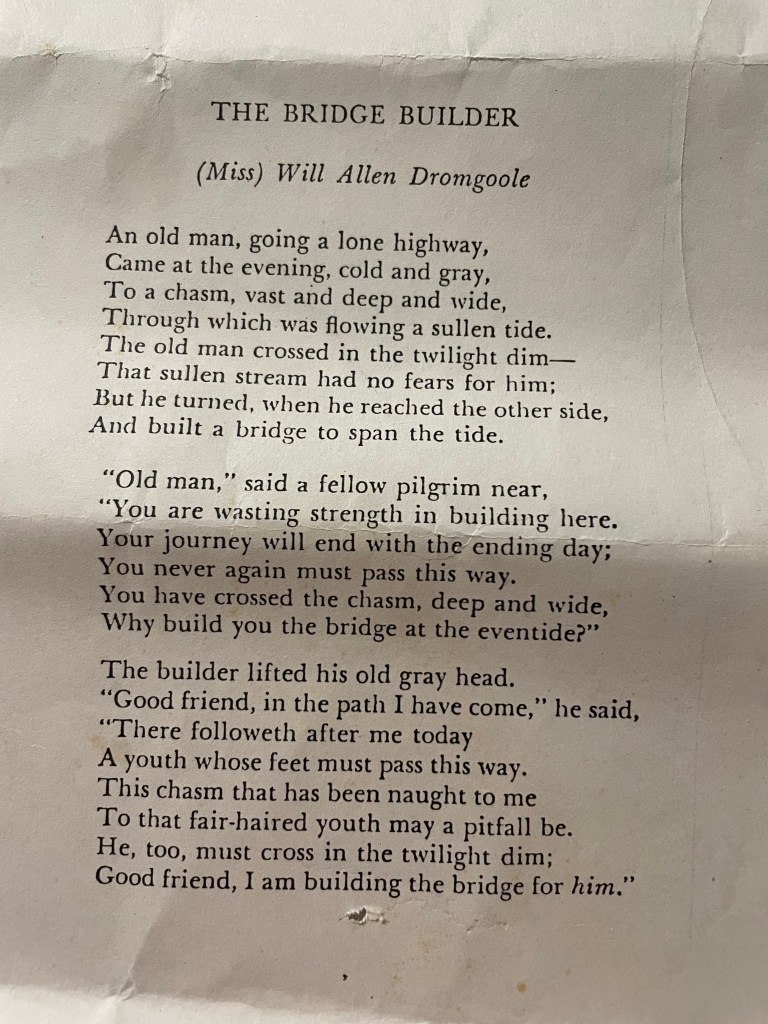
One constant that stands out in my mind is my Father-In-Law’s love for Christmas: the decorating, the gift giving, and the food! He took special pride in decorating the outside of the house, expertly hanging wreaths on every window with a velvet ribbon coming down from the top, and meticulously stringing garland across the wooden fence (as early in the season as he could get away with)! As we were in the basement, sorting through some of those prized Christmas things on a table, at the bottom of one of the stacks, laying flat on the table, was a copy of the old poem, “The Bridge Builder.” Being vaguely familiar with this poem, I stopped my sorting and read it with fresh eyes.
The Bridge Builder
By: Miss Will Allen Dromgoole
An old man, going a lone highway,
Came at the evening, cold and gray,
To a chasm, vast and deep and wide,
Through which was flowing a sullen tide.
The old man crossed in the twilight dim-
That sullen stream had no fears for him;
But he turned, when he reached the other dside,
And built a bridge to span the tide.
“Old man,” said a fellow pilgrim near,
“You are wasting strength in building here.
Your journey will end with the ending day;
You never again must pass this way.
You have crossed the chasm, deep and wide,
Why build you the bridge at the eventide?”
The builder lifted his old gray head.
“Good friend, in the path I have come,” he said,
“There followeth after me today
A youth whose feet must pass this way.
This chasm that has been naught to me
To that fair-haired youth may a pitfall be.
He, too, must cross in the twilight dim;
Good friend, I am building the bridge for him.”
By the time I took in the meaning of the last line, my eyes were already flooded with tears. It was as if that sheet was put there for such a time as this. That is what they did for their family, I thought, they built a bridge. With tradition, stability, and love, they built a life on which those coming behind could build as well.
And isn’t that what we should all strive to do – build our lives so that those coming behind can see the way, can know a sure and strong foundation? So, when challenge and heartbreak come, “the chasm deep and wide,” that is a part of every life, we have a way to “cross in the twilight dim.”
Of course, this principle applies not only to our own personal lives, but also to the Body of Christ, the Church. We do our “building” not only for ourselves and the needs of the current moment, but for those who will come after us. It is often said that we are “planting shade trees that we will never sit under.” We plant so that others might enjoy the cool shade one day. We build and plant and work so that others may know the peace, the joy, the salvation that is found in Jesus, our Chief Cornerstone (Ephesians 2:20). With the strong foundation of His Word, and complete trust in His sovereignty, let us build our bridges well.
“Let this be written for a future generation, that a people not yet created may praise the Lord.” (Psalm 102:18)
We can learn a lot from minor characters in the Bible. As I was reading Luke 23 this morning, I zeroed in on something I had not thought about before – the important role of Joseph of Arimethea in the burial of Jesus. All four gospels mention Joseph and he is described in Matthew as “a rich man and a disciple of Jesus.” The Bible says in Luke 24 that Joseph was a “good and righteous man,” and again in Mark 15 that he was “a respected member of the council.” In both passages, it says that he was “looking for the Kingdom of God.”
Whatever he had been looking for, He obviously believed he had found in the person of Jesus Christ. Who knows if he had perhaps heard rumblings of a resurrection story yet to come, or maybe he just wanted to give this Great Teacher a proper burial. Whatever the reason, he took action. Mark 15 goes on to say Joseph “…took courage and went to Pilate and asked for the body of Jesus.” He asked for the body in order to bury Jesus in his own tomb. He took action that required some boldness, as he played his role in the greatest story ever told. He did not sit around and wait for someone else to act, but no doubt asked himself, “What can I do?”
What about us? Are we “looking for the Kingdom?” Are we asking, “What can I do?” Are we willing to take bold action, to play our part, to participate in His plan? In our churches, our families, our communities, I pray we “take courage” and take on the hard things. May we live boldly, love deeply, and follow faithfully, all for His Kingdom’s cause.