He sees you He sees you in the day to day The mundane tasks, the ho-hum He sees you as you wipe that little nose for the hundredth time And change the smelly diaper He sees you as you clean up After a dinner you have fixed for hungry mouths He sees you rise up for another day and give Him thanks He sees you worship He sees you give of yourself He sees you because He is intimately acquainted with you He sees because He loves you He sees you
Why do people take offense? Today more than ever, people seem to be quick to be offended by what, in past times, would have been very innocuous statements. When feelings and self are exalted above all else, becoming easily offended is a natural consequence. Sometimes offense occurs because we perceive the offending person did not properly respect our position, our characteristics, or our opinion.
It seems to me, at the root of all offense , though, is the deadly sin of pride. Pride is the opposite of love. Pride seeks its own, while love is unselfish. Pride is arrogant and rude, while love is patient and kind. Pride insists on being right, but love rejoices in the truth.
1st Peter 4:8 says, “Love covers a multitude of sins.” I dug a little deeper in that verse recently. It could really say love covers a multitude of “other people’s sins.” One commentary said, “Where love abounds, offenses are frequently overlooked and quickly forgotten.”
I thought about when our children disappoint us, or even “sin” against us, how easily we can forget. We don’t stop loving them or hold things against them- we are quick to forgive. That is what Love does.
How would our homes, our churches, our workplaces, and our schools be different if we just Let Love Cover It, instead of taking offense?
God is a God of order. He brought order out of chaos. He never intended for us to live at a phrenetic pace, with no time for quietness and rest.
Our lives have seasons, to be sure, with varying levels of activity. The Spring of life may be filled with new hope, new experiences. Summer may be a time of harvesting some of those things we planted earlier, a time to roll up our sleeves and work hard. Fall can be a drawing in, of gathering around hearth and home, where love and contentment abound. We may trudge though a cold, hard Winter, where we walk through the valley of the shadow of death with a loved one.
It seems that whatever season we are in, we are always struggling for balance. If we are raising children, we may be overwhelmed with various demands and feel like we have no time to just “be still.” On the other hand, empty nesters and those left alone by the death of a spouse, may find they have too much quiet, and long for the days of activity and interaction. Human beings always seem to struggle with balance. We need rest, but we need activity and stimulation. We need fellowship and friendship, but we also need time to ourselves.
One thing you can be sure of though, is that if life feels chaotic, that is not a part of God’s plan for you. He designed you to work and then rest. There are things to be discovered at every age, but at every stage, we should be seeking the will of the Father.
“Be still, and know that I am God,” (Psalm 46:10) is one of the most well known verses of Scripture, but the surrounding verses in Psalm 46 give us context. It starts out by saying, “God is our refuge and strength, a very present help in trouble.” Then in verse 2, “Therefore we will not fear, though the earth gives way, though the mountains be moved into the heart of the sea, though its waters roar and foam, though the mountains tremble at its swelling.” The Psalmist goes on to tell us what God will do, “The nations rage, the kingdoms totter; he utters his voice, the earth melts…He makes wars cease to the end of the earth. He breaks the bow and shatters the spear.” This is all before He tells us to “Be still.” He is doing the work, and simply tells us to, “Be still, and know that I am God.”
In other words, no matter what is going on around you, He is at work, and He wants us to rest in his ability to handle the hard things for us. He is God, and we are not. So today, move in the awareness of His presence, his goodness, his love.
I love a good book. Audio books and e-books books are popular, but to me there is nothing like holding a book in your hands. Regardless of which form you choose, when you get right down to it, a book is one of the few things that really has the power to change someone’s life.
Books can contain information needed to learn a skill for a career, to think more clearly about a situation, to solve problems, to understand yourself better, or sometimes even to state the obvious in a relatable way. And, of course, many books are written for the story, simply for pure enjoyment.
But the Book of all Books contains the precepts on which we can build our lives, the precepts which cause us to turn to God Himself as our Life Changer, Holy Spirit as our Truth Teacher, and Jesus as our Savior. He changes us into his likeness from Glory to Glory (2 Corinthians 3:18), and a transformed life is the result.
The Apostle Paul says in this passage that the Corinthian people are “epistles written on our hearts…written not with ink but with the Spirit of the Living God, not on tablets of stone, but on tablets of the human heart” (2 Corinthians 3:2-3). In essence, he is saying the we have become the books, when our lives reflect the truth of Christ.
Is your life a book others can read and find the story of God’s love written there? I pray that it is, and that those who read your book and mine, will find the hope only He can give, written on the pages of our hearts.
One of the principles I have held to throughout my adult life is that you can do almost anything, as long as you know it won’t last forever. I believe that. You may have a situation that is trying your patience to the core. I guarantee you, it won’t last forever. If it’s a child you are struggling with – children grow, and go in and out of phases that both delight and test you at the same time. If it’s a job situation, things often change within a work environment, or you can choose to make a change. If it’s being separated from a loved one through work, military service, etc., you know there will come a time when you will be together again. You have hope. As long as there is a glimmer of hope, you can keep going, keep working, keep pushing through, until the time when the expectation of something better is realized.
I’ve been thinking about hope a lot lately. The word “hope” has an interesting meaning in Hebrew, which I learned recently from listening to Rabbi Jason Sobel. The Hebrew word for hope is “Tikvah,” and it means “expectation”. It also means “cord” or “rope,” which comes from a root word that means “to bind” or “to wait for”. What does a rope do? It holds us fast, makes us secure; it can save us. Think about a rope being thrown to someone who is drowning, or holding someone as they climb a mountain. In those situations, a rope is literally a life-saver. Something is required of us too, though, in that we have to take hold of the rope and not let go. If we lose contact with the rope, there are dire consequences.
The Bible tells us that our God is a GOD OF HOPE. Romans 15:13 says, “May the God of hope fill you with all joy and peace in believing, so that by the power of the Holy Spirit you may abound in hope.” His hope both holds us steady in the here and now, and reminds us of the expectation we have of Heaven.
1st Peter 1:3 says, “…according to his great mercy, he has caused us to be born again to a living hope, through the resurrection of Jesus Christ from the dead…”
This is our ultimate hope, a holy expectation, that through Jesus’s death and resurrection, we have new life in the here and now, and security for the life to come. We have the hope of perfect peace, unbridled joy, and transformed lives through the power of the Holy Spirit. We have the hope of greater things to come.
So, be encouraged today, and remember to hold onto the Rope of Hope.
Miracles. So much has been written and said about them. Why do they occur and why does God seem to intervene with a miracle in one situation, and remain silent in others? Why did God use miracles throughout scripture, and why and how does he use them today?
I like the way CS Lewis explains miracles in his essay by the same name. He says, (paraphrasing) that the operations of the world and the laws of nature are indeed miracles, but because that is our “normal” we do not see the rising and setting of the sun, the growing of plants and of humans, and other processes that happen daily, as miraculous. When crops come in year after year, he says, and result in bread being made, we don’t regard it in the same way as Jesus multiplying the loaves, although it is just as much of a miracle. When grapes grow on the vine and are harvested for wine, he continues, we are not as amazed as when Jesus turns the water into wine, even though it is all accomplished by God’s hand.
When all the components of our body systems work so that we can live and move and think and breathe, we don’t see it as a daily miracle. Perhaps at times we will ponder such things but in the coming and going of everyday life, most people are not actively perceiving those things as miracles. The kinds of things we think of as miracles happen outside the laws of nature, beyond our “normal.”
Scripture tells us that part of the reason Jesus performed miracles was to confirm his identity, so that we would believe he was who he said he was. His miracles were to strengthen our faith, to “confirm the message” (Mark 16:20), as well as to be of benefit to the recipient of the miracle. The first prerequisite for a miracle is that there is a need. Through this need then, God has an opportunity to operate outside the laws of nature and demonstrate his power. If his miracles were only meant to amaze people, he could have done things that appeared more like magic tricks. Those things, too, would have been operating outside the laws of nature, but would not have served to demonstrate the larger miracles all around us.
Again, to draw on the wisdom of Lewis, “Each miracle writes for us in small letters something that God has already written, or will write, in letters almost too large to be noticed, across the whole canvas of Nature.” When Jesus healed a physical body, he was doing on an individual scale what the natural bodies of all humans do to heal themselves when there is sickness or injury. Many physicians will be the first to acknowledge, even with the advent of amazing medical advances, that they merely aid the body in healing itself.
Jesus healed people in a variety of ways while he was on the earth – sometimes he touched them, sometimes they touched him. Sometimes he prayed or spoke the word when the person was not even in his presence, and healing came. One time he told 10 lepers to go and present themselves to the priest – an act of obedience and faith – and ON THE WAY, they were healed (Luke 17). That phrase really jumped out at me as I read it – ON THE WAY. They had to start walking, with no evidence that the healing would come, they simply obeyed the voice of Jesus.
Maybe you’re reading this right now and you are in need of a specific miracle in your life; maybe there is a situation that you think has no possibility of being resolved, or you need healing in your body, or some other situation that only you know about. I don’t mean to oversimplify, but maybe this simple question is for you – what has he asked you to do?
Maybe your healing or solution happens ON THE WAY as you walk in faith – as you step out and start moving.
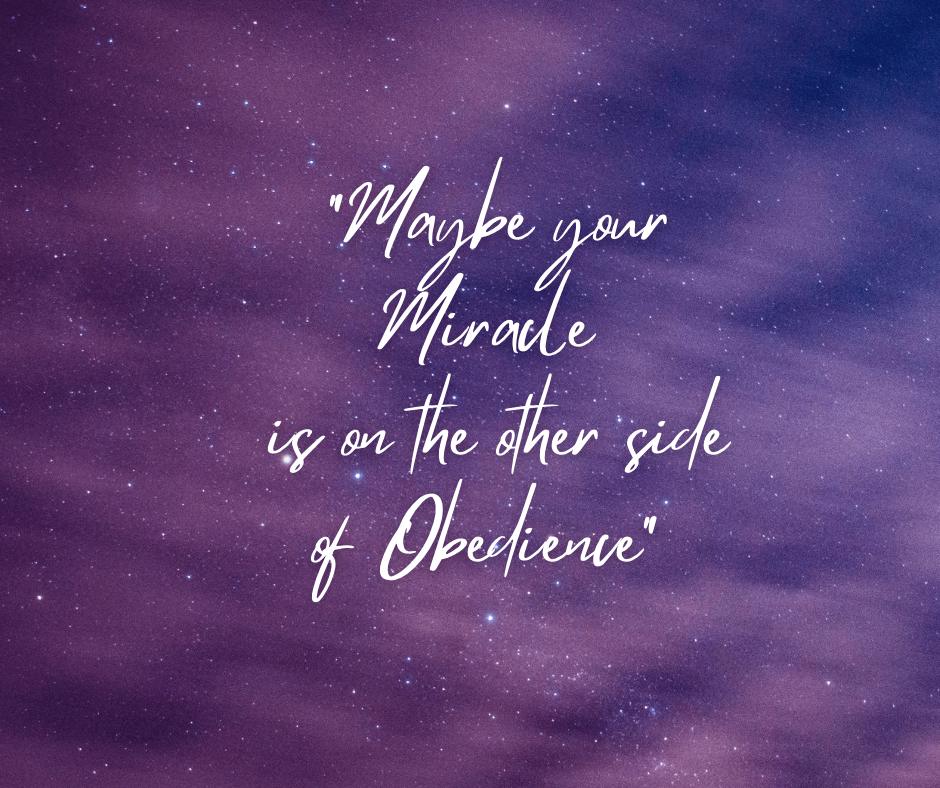
Maybe your miracle is on the other side of obedience.
I almost titled this post, ‘Trust Your Feelings, Luke?” in homage to that old line from Star Wars. In that make believe world, Luke was encouraged to trust his feelings, but I want to ask each of you a question.
Have your feelings ever steered you wrong? Have you ever been absolutely convinced of something, and then your feelings did a 180 degree turn after some time went by, or when you got some new information? Maybe you thought you were in love as a teenager, but if that relationship had remained, you would not have met your spouse and your life would have taken a totally different trajectory. Or how about misjudging someone’s character initially – maybe you were sure about an opinion or a feeling you had about someone, and then found out that person was much different than you thought? Or have you ever been so angry or sad or depressed that you felt like you wanted to end it all, thinking the world would be better off without you? Most of us can likely relate to at least one of those situations, and you can probably think of other instances where feelings let you down. Feelings that, had you followed through on them, could have led to disastrous consequences.
In today’s society, it seems honoring and being true to one’s personal feelings is considered the pinnacle of virtue, and happiness is the worthiest goal of every life. But, in actuality, focusing on our feelings is the very opposite of Godly wisdom. From the time we are born, our parents and others are helping to shape us into people who can offer something to the world we live in. Think about how we train toddlers – they have very strong feelings! No one has to “teach” a toddler how to be selfish, disobedient, or how to lie. No, we teach them how to be self-LESS, how to share, and how to tell the truth, even when telling a lie seems more comfortable. We teach them to have self-control, rather than to be totally controlled by, and at the mercy of, their own emotions.
As they grow, we teach children how to be tactful, how to be considerate of others. We don’t tell them to “just be yourself” without regard to others – no, we are constantly molding and shaping them to be BETTER people. If left strictly to their “feelings,” many children would not go to bed at a decent time, not go to school, and not eat properly. Having control and mastery over our feelings keeps us from doing all kinds of destructive things to others and even to ourselves. Lack of self-control, and just doing what “feels right” at the moment, is often a recipe for disaster.
Proverbs 25:28 describes a man without self-control as being “like a city broken into and left without walls.” If you don’t have walls, you are open to attacks of the enemy, you are without protection.
While “feelings” are exalted above all in the culture today, there seems to be a sense that there is something that still needs work within ourselves – otherwise why would there be such a plethora of “self-help” books? But in these books the advice is usually centered around “self-care,” doing what your heart tells you, living your best life, etc. This is all antithetical, however, to how the God of Scripture wants us to view and live out our lives.
Jesus never said, “Be sure and take care of yourself, put yourself first,” but rather, “If anyone would come after me, let him deny himself and take up his cross and follow me. For whoever would save his life will lose it, but whoever loses his life for my sake will find it” (Matthew16:24-25). He gave us the example of servant leadership when he humbled himself and washed his disciples’ feet. “The greatest among you will be a servant,” he told his disciples when some wanted top status in the Kingdom. In other words, we are not to put ourselves, our desires, or our own personal happiness at the top of the hierarchy of priorities. Not every emotion we feel, or thought that pops into our heads, is equally valid or worthy of expression.
So, are emotions bad? Should we ignore our feelings? By no means! Our emotions and feelings can be the impetus for unselfish acts of kindness, and for loving our families and others well. Sometimes feelings warn us of harmful situations, or signal something is “off.” In my work as a pediatric OT, I often find myself repeating to parents what a wise instructor said in a continuing education course I attended, “All behavior tells you something.” Sometimes we just have to figure out what that is, in order to stop a negative behavior. I think the same could be said for feelings– all feelings tell you something.
As Christians we should examine how our feelings align with what God’s word says and His expectation of holiness in our lives. Jesus says he will give us a “peace that passes all understanding.” Do I feel that peace? The Joy of the Lord is our strength (Nehemiah 8:10). Do I feel joy? Peace and joy are fruits of the Spirit, and the presence of the feelings of peace and joy are indications I am being led by the Holy Spirit.
What about the negative feelings we experience? Again, examine the source.
When I’m angry, does my anger have a righteous cause, because of injustice or because someone is being mistreated, or is my anger rooted in pride, stubbornness, and wanting my own way? Jesus demonstrated anger when he drove the merchants out of the temple, but it was a righteous anger, because the merchants had made the Temple a place where goods were bought and sold instead of a place of prayer and worship. Some commentators also surmise that part of Jesus’s anger was because the merchants often cheated the poorest of people, which were usually the women and widows, as they sought to buy sacrifices outside the temple. Jesus’ anger was righteous on both counts.
Am I experiencing negative emotions because of jealousy, or unforgiveness, or fear of missing out? Is the sadness or depression I feel, rooted in an intense focus on the self? In every situation, we must examine our feelings, but not exalt them. Feelings can be good when properly assessed and addressed but can also be the “gateway drug,” so to speak, that leads to living a life so intensely focused on the self that it can never bring contentment. That kind of life always has us seeking the next situation we think will bring us happiness.
Jesus says, “Seek first the Kingdom of God and his righteousness.” (Matthew 6:33). Seeking the Kingdom is always outwardly focused, not inwardly focused. We seek the Kingdom by giving, by serving, by worshipping. And all that is more than just a feeling.
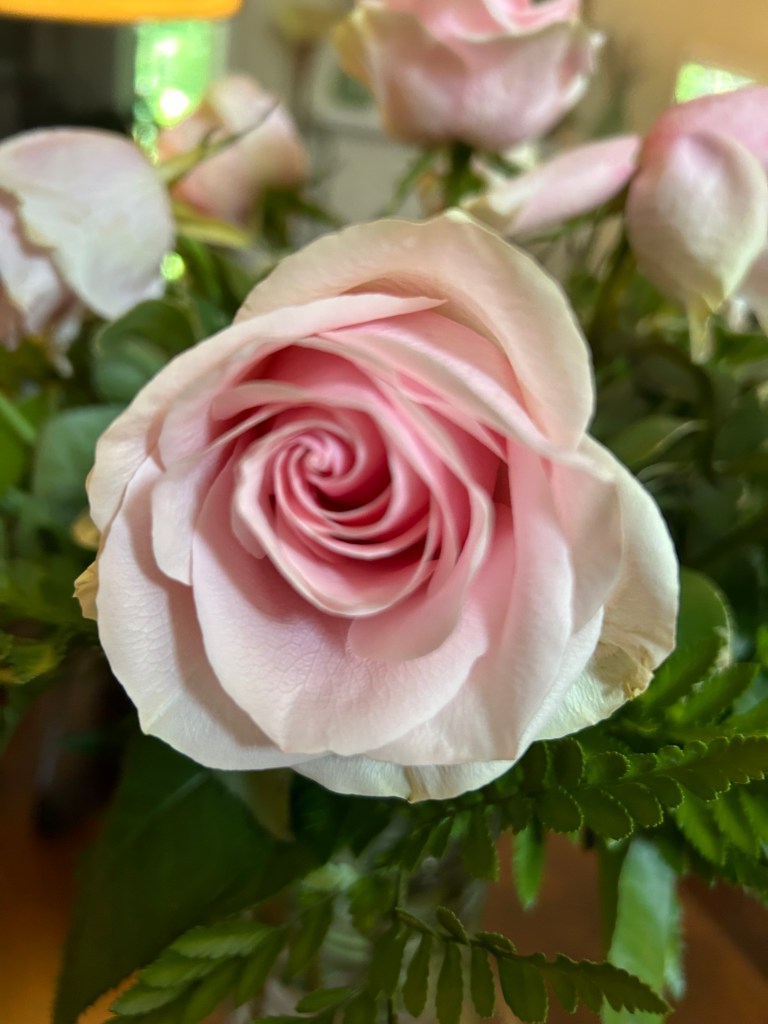
I have a sweet friend who sent a dozen pale pink roses to me for my birthday. They were beautiful when they arrived, but over the next few days they opened up and became even more gorgeous. I placed them on a table in a prominent place in our living room to enjoy them every minute that I could. On the table there is a lamp to the right, and on the left is the foyer area, with a lot of natural light. This is what I noticed about those flowers over the next few days – the flowers facing the side of the artificial light did not open as much as the ones facing the greater light source, and by the end of the week, the ones on the right side even began to droop a little. Things grow toward the light.
How like our lives, I thought. We can get some pleasure from an “artificial” source, but the true source of life and light is what brings us to our full potential, and gives us that beautiful opening up of our hearts and lives to others.
In John 8:12, Jesus says, “I am the light of the world. Whoever follows me will never walk in darkness, but will have the light of life.” Our culture has become so dark, with all kinds of depravity, and desperately needs to know the real source of light. So don’t settle for artificial when you can have the real promises, the real life, the real light, found in Jesus Christ.