Always seek to speak the truth, especially to yourself. I once knew a girl who sang on a praise team – she said when she first started singing, she wasn’t even sure if she believed the words. But the more she sang the truth, the words with the power to transform, the more she started to believe them.
Whatever you say to yourself, or proclaim out loud, begins to take root in your heart, so make sure you are speaking truth grounded in the Word of God. But how do we know what truth is, in this world or moral relativism? Jesus said, “Thy word is truth” (John 17:17). Not just, “Thy word is true,” but his word is truth itself. Conversely, Jesus says Satan is “the father of lies” (John 8:44). He is the author of the counterfeit and the distorted.
So confess the truth as you abide in him. Speak who you are and what you have according to Scripture:
I am the righteous of God in Christ Jesus – 2 Corinthians 5:21
I am redeemed – Romans 3:24
I am more than a conqueror – Romans 8:37
Nothing can separate me from his love – Romans 8:39
I am made in God’s image – Genesis 1:27
I am loved – John 3:16
I am chosen – John 15:16
I am forgiven – 1 John 1:9
I am adopted – Ephesians 1:5
I am his workmanship – Ephesians 2:10
Speak who God is and what he does:
He is Creator – Genesis 1:1
He is Savior – Romans 1:16
He is Awesome – Psalm 95:3-5
He is Majestic – Psalm 8:1
He is Love – 1 John 4:16
He is Kindness – Titus 3:4-7
He is the God who sees – Genesis 16:13
He is Healer – Exodus 15:26
He is Provider – Genesis 22:14
He is the Beginning and the End – Revelation 22:13
He is Lord – Deuteronomy 7:9
He is a Shield – Psalm 3:3
He is our Rock – Psalm 18:31
He is a present Help in time of trouble – Psalm 46:1
I was recently a “helper” at my church for a preschool graduation. As the small students processed in and out of the worship center, they passed by me at the door. I was standing beside a large, beautiful wooden cross that gets moved around our building as needed.
As one little boy passed by, he asked in an awed voice, pointing at the cross, “What’s that?” I said, “It’s a cross,” even then, thinking about what I would say to him if he asked any more questions. “We learned about that at my church,” he said. “Oh, that’s good,” I returned. Then I thought, what else should I say to him? What words can you say to a 4 year old to convey the meaning of the cross in a sentence or two? I thought I could say, “The cross is life.” Something simple, but something he might remember. But maybe, I thought, he knew that Jesus died on the cross, and it might be confusing for him. In the split second it took me to contemplate, the moment was gone as he followed the line back to the classroom.
I thought about that later, and how the cross does represent death, a horrible death, but it ultimately brought us life, and how so many paradoxes are central to Christianity:
Death leads to life
Be a servant to be great
Lose your life to find it
His strength is made perfect in our weakness
Give to receive
Become like a child to have great faith
Pray for your enemies; bless those that curse you
Faith the size of a mustard seed can move a mountain
In this Kingdom, the last will be first and the first last.
What was death to Christ meant life for us; his sacrifice, our gift.
Another seeming paradox is that the truth of the gospel is so profound that it compels the brightest minds of this age and ages past to contemplate it at the deepest levels, yet it is so simple that a child can understand and embrace it.
I hope that little boy learns more about the cross, and that one day he’ll find, like millions before him, the Cross Is Life.
There’s a danger in watching too much HGTV. The problem is, no matter how satisfied you might be at the time, after you see all the “new” things and improvements to houses, you may feel that your home needs an upgrade too. Seeing the latest and greatest can make you crave what you don’t have. Scrolling social media can also have this effect as you look at other areas of life. It can cause us to covet others’ possessions, or their situations, or their vacations, or whatever the case may be. The comparison game is not healthy and can lead to feelings of discontentment, and even discouragement. Instead of being thankful and content, we become fixated on the next “thing” that we think will bring us some measure of happiness.
But, have you ever noticed, when you get something new – maybe even something as significant as a new car, soon the “new” wears off? The charm does not last forever. I read a recent article that stated most people are dreaming of their next vacation while on vacation! Some of this craving for the next thing may be rooted in a desire for forward motion and progress, but I believe some of it is rooted in poverty of the soul and spirit. Poverty because of neglect and indifference to the inner life.
Over and over in Scripture we are reminded to “be thankful,” and to “rejoice,” even in the midst of difficult circumstances. We’re told by the experts of our day that “gratitude” is one of the attributes most associated with personal happiness. So how do we cultivate this “attitude of gratitude,” this inner garden of peace and tranquility, that will grow and thrive despite seasons of need or abundance?
Colossians 3:1&2 tells us to “…seek the things that are above,” and “…set your minds on things that are above, not on things that are on the earth.” In verse 5, the apostle Paul even goes so far as to say, “Put to death therefore what is earthly in you,” naming “covetousness” as one of those earthly things which leads to idolatry. Romans 12:2 admonishes us, “Do not be conformed to this world, but be transformed by the renewal of your mind.” Transformation occurs when we focus our minds on what matters.
I am reminded of the story of Mary and Martha, from Luke 10, where Mary is sitting at the feet of Jesus, taking in his teaching. We’re told Martha was busy with food preparation, and we can picture her bustling around in the kitchen, trying to make sure everything is done properly. She expresses to Jesus that she is not happy about being left to do all the serving by herself, and she wants him to tell Mary to help her. But Jesus, in a gentle rebuke, evidenced by the use of him saying her name twice, says, “Martha, Martha, you are anxious and troubled about many things, but one thing is necessary. Mary has chosen the good portion, which will not be taken from her.” I can only imagine what the “many things” were that Martha was anxious and troubled about, probably many more than just the meal she was preparing at the moment.
Jesus tells her what she should prioritize -time with Him, sitting at his feet. This is the good portion, the thing that is eternal, the thing that lasts. Instead of “good portion,” some versions say, “the better thing.” Sitting at his feet is more important than the striving, than the meal prep, than the house being clean, than the car, the vacation, the home makeover, etc, etc.
Years ago, as a much younger woman just discovering these truths, I wrote the lyrics to a song called “The Better Thing,” as I was learning this way of sitting at his feet, of being still, of being thankful.
I’m still learning this life, but one thing I know
Lent and Advent are seasons of contemplation, perhaps more than any others. While during Lent, we focus on Holy Week, and all things leading to the cross, I have found myself musing on the life of Jesus before his years of formal ministry. He did not choose to come as an earthly king or military leader, as some supposed he would, but as we know, he came in the very humblest of conditions, to the very humblest of families. In this family he would learn a trade – a trade that would reflect who he was. He chose to be a carpenter – to build, to create, because that is his nature – to take something raw and primitive and make something beautiful, useful, out of it. He demonstrated this when he made everything in the beginning, and he does the same when he shapes a human heart into a new creation. His earthly occupation could be nothing less than one who fashioned things from his hand.
He chose to be a carpenter A shaper of the wood No doubt he made some useful things And they were very good
He chose to be a carpenter To fashion with his hands The wood that he created It was the Master Plan
He chose to be a carpenter To wear our human skin To work and toil and to fulfill Redemption’s perfect plan
He chose to be a carpenter A maker of beautiful things His earthly occupation Could be no less than this
For he takes the human heart Raw and rough and cold And fashions it to please his heart His work makes us his own
He chose to be a carpenter He chose to condescend He chose to give his life away To shape our hearts for Him
Don’t you love it when you read a passage of Scripture and something jumps out at you that you had not noticed before? Sometimes it may be the Holy Spirit giving you that insight or it might be simply your own mind discerning more of the richness of Scripture, but either way it is a treasured experience. This happened to me recently when reading the story of the Prodigal son in Luke 15.
In verse 20 when the son is coming home, it says, “And he arose and came to his father. But while he was still a long way off, his father saw him and felt compassion, and ran and embraced him and kissed him.” That phrase “while he was still a long way off” struck me. The son was working his way back home – he was not there yet, but the father saw him and looked on him with compassion. The father ran to him, just as our Father runs to us, and is always pursuing us with his love. Even when it may seem we are “a long way off,” still he looks on with compassion, knowing we are headed toward him.
Maybe you know someone like that – I sure do. Maybe someone you love is making their way home but still a long way off, a long way from where they should be. Maybe you yourself are that someone.
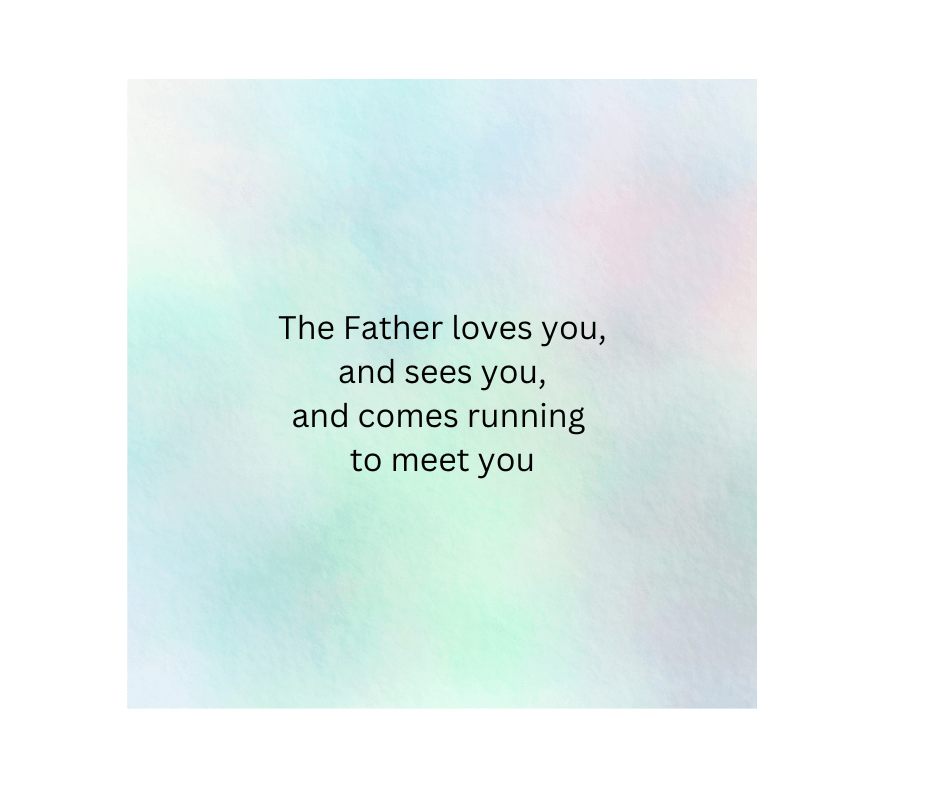
Whatever the case may be, rest assured the Father loves you, and sees you, and comes running to meet you.
Deconstruction. What a sad word. It implies an undoing of something that is complete and whole. Deconstructing is far easier than constructing.
In my work as a pediatric occupational therapist, I often see children whom I call my “deconstructors.” They are not yet able to grasp the concept of a particular activity but will seek to “undo” whatever the activity is – knocking down blocks, or pulling apart Legos, or taking puzzle pieces out of a puzzle rather than completing it.
Think about a very tall building, which took years to construct. It can be brought down in a matter of seconds by any number of things. Tearing something down is easier than building with care and purpose.
Things in our own lives can be deconstructed too without much difficulty – things which take years to build – a marriage, a friendship, a reputation, a career, and even our faith. So, what do we need to do to keep ourselves from becoming our own worst enemies, from the possibility of deconstructing those things most valuable to us?
We start with a firm foundation, based on Truth. We must know what truth is and where we can find it. Jesus says that he IS the truth in John 14:6. Many people quote John 8:32, probably without even knowing it comes from the Bible – “You will know the truth, and the truth will set you free.” Jesus said those words, but we must understand them in the context of verse 31, which is the first part of his statement, “If you abide in my word, you are truly my disciples, and you will know the truth, and the truth will set you free.” He is not just talking about knowing a set of facts, but about living in the very essence of truth found in him and his word. This is our foundation and the only thing worthy of building on.
“Thy word is truth” (John 17:17). Reading his word and knowing it – abiding in it – is the only way to know the truth. Without it we can get sucked into the vortex of moral relativism. Truth is not found within ourselves or our own hearts, but in the God of Scripture. Truth is not synonymous with our feelings. Our feelings can change like shifting sands, but we can build on the firm foundation of his words and precepts. Titus 1:1 states that “knowledge of the truth accords with righteousness.” If we know it, we can more easily do the right thing when challenges come, and difficult decisions have to be made.
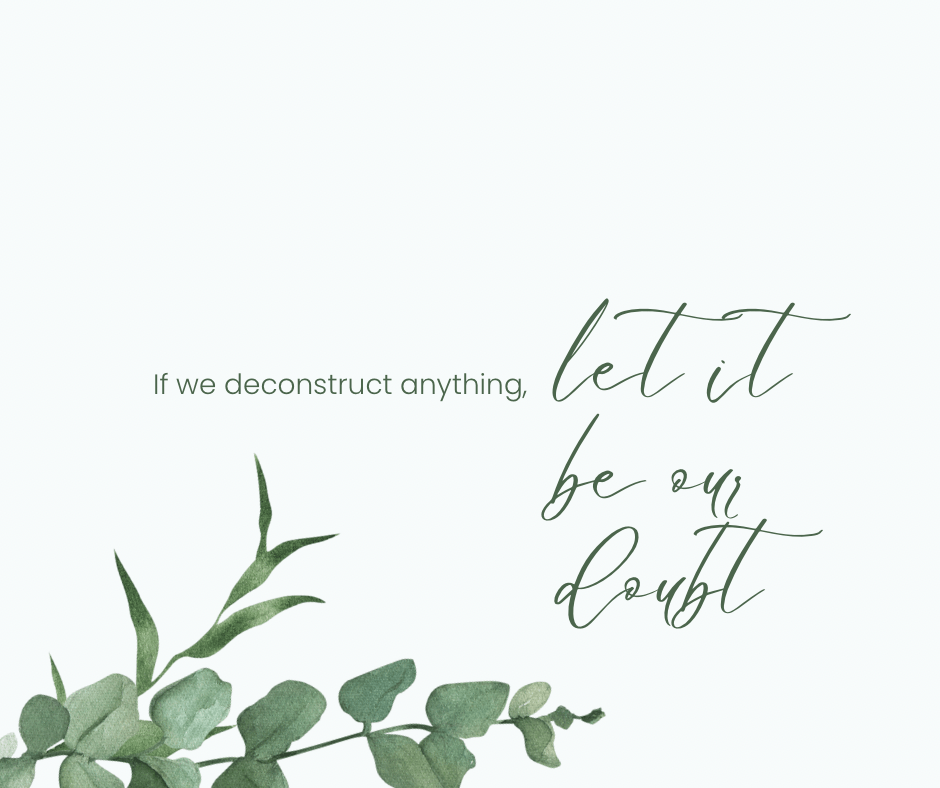
If we deconstruct anything, let it be our doubt, and let us cling to the truth like the life raft it is.
“Therefore, if anyone is in Christ, he is a new creation. The old has passed away; behold, the new has come.” 2 Corinthians 5:17
What does it mean to be “in Christ?” That phrase (in Christ) is used around 180 times in the New Testament, depending on the translation you use. The dictionary definition of the word “in” is “…the situation of something that is enclosed or surrounded by something else.”
If we are in Christ, then, he is surrounding us – people should see Him before they even take notice of us. Jesus says of himself that he is meek and lowly of heart. Do our lives reflect that? Do we want people to see Him and his character first, or are we more concerned with people noticing our physical characteristics, or our position, or whatever it is we think gives us value and uniqueness?
If we are surrounded by, or enclosed in something, it also gives us protection. If we are in Christ, we are protected by Him. That doesn’t mean anything bad will never happen to us, but it means we have security, whatever may come in our lives. We can trust in his provision, his protection, and his working things together for our good (Romans 8:28), for the here and now, and ultimately for eternity.
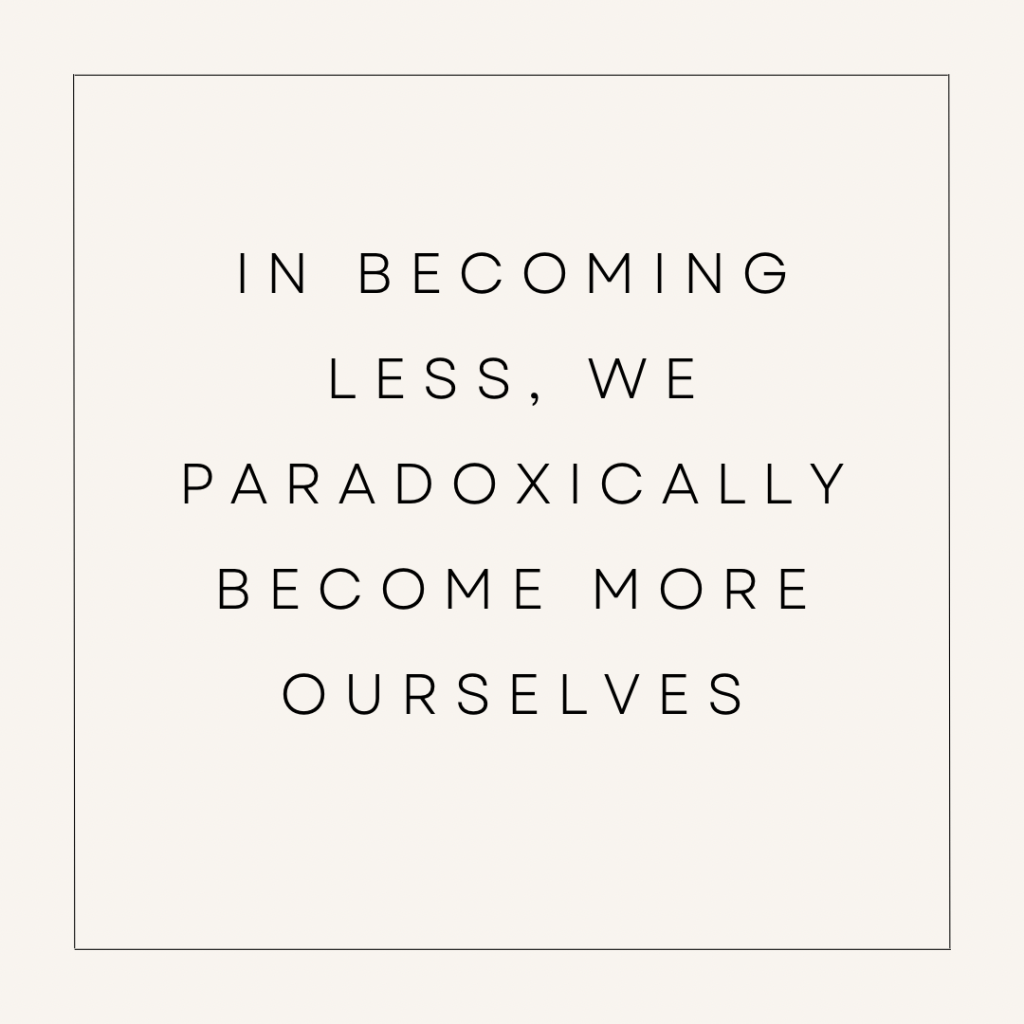
If we are “in Christ,” we are allowing him and his character to overtake our own personal desires or ideas. He becomes more, we become less, but in becoming less, we paradoxically become more ourselves.
CS Lewis put it this way, “The more we let God take us over, the more truly ourselves we become – because He made us. He invented us. He invented all the different people that you and I were intended to be…. It is when I turn to Christ, when I give up myself to His personality, that I first begin to have a real personality of my own.”
Perhaps most importantly, if we are “in Christ,” when God looks at us, he doesn’t see us, but the righteousness of Christ. We don’t stand before him dressed in our own righteousness but clothed in His.
“For our sake he made him to be sin who knew no sin, so that “in him” we might become the righteousness of God” (2 Corinthians 5:21).
Surround us Lord Jesus, we want to be found in you.
Fear. It can paralyze us or send us running for cover. It seems to be in our nature to look at our circumstances, and at times be held hostage to our feelings. Our moods sometimes rise and fall with our feelings, and we can easily be overcome with anxiety and fear when faced with trying times, or the unknown.
Even the disciples experienced fear, though Jesus was physically there with them. We wonder how they could be afraid of anything, when the Son of God was in their midst. But, we are reminded that they were human, and while we look at the scriptures as third person observers, they were living the things we now read about which seem clear to us. I think of the passage in Mark 4 where Jesus and the disciples were on a boat and a great storm came upon them. The Scripture says the waves were breaking into the boat, but Jesus was comfortably asleep on the stern. They woke him up in fear, and he did calm the storm, but then admonished them for their lack of faith. He spoke peace into the circumstances and then asked, “Why are you so afraid? Have you still no faith?” We tend to forget quickly all the ways God has been with us in the past, to look at our situation rather than our Savior.
But sometimes fear is more subtle. It is often easier to keep the status quo than to venture out into the choppy waters where faith is required. I find it interesting the people who witnessed the miracle and the transformation of the demon possessed man in Mark 5 were afraid AFTER he had been delivered, and not before, even though he was described as “living among the tombs,” and that “no one could bind him anymore, even with a chain. For he had often been chained, hand and foot, but he tore the chains apart and broke the irons on his feet. No one was strong enough to subdue him. Night and day among the tombs and in the hills he would cry out and cut himself with stones.” This is quite a scary picture, yet it was only after the demons were cast out, and they saw the man “clothed and in his right mind,” that the people were described as fearful. Perhaps they were afraid of the power to which the transformation bore witness.
Fear of change is often one of our greatest fears, particularly when the change is to take place within ourselves. Are we afraid of the transformation that is inevitable in a fully surrendered life? How often do we settle for living on the edge of the water, so to speak, instead of diving in where the water is deep, but where still deeper faith is required? You can only wade around in the shallows, you cannot swim.
Are we satisfied with where we are, or maybe where we have been for a long time? Or is there a desire to venture forward, into the unknown? Maybe God is calling you to give something in the way of material possessions, or to open your home to someone with a need, or to mentor someone.
Fear can stop us from fulfilling God’s purposes for our lives, from stepping out and stepping up. Dear One, listen to that “still, small voice” that may be nudging you, and move forward, knowing that faith is greater than your fear.
At our church, we love to sing a song called “The Reason.”
Some of the most poignant lines are these:
Everything that I have, all my worship I bring
You’re the reason I live
You’re the reason I sing
As we sang this song recently, I thought about those lyrics, and what they might mean to the ones singing them. I thought about the fact that worship is something we can all bring – we don’t all have the same gifts, skills, and resources, but we can all bring our worship to Him.
But what does it mean to “bring all our worship?” Jesus said, “…true worshipers will worship the Father in spirit and in truth, for the Father is seeking such as these to worship him” (John 4:23).
Worship is a heart speaking its full surrender to the Father.
Worship means giving him our devotion, our very hearts.
Worship is the adoration of One greater than ourselves, and our submission to him.
So, worship is something we can all bring, but do we? Do we offer our hearts, our minds, our lives, in this way? Hebrews 13:15 says, “Through him then let us continually off up a sacrifice of praise to God, that is, the fruit of lips that acknowledge his name.”
“Praise” itself demands a sacrifice. True worship requires a laying down of our will to his, our pride to his glory, our dreams to his plans for us.
I hope we can say together, “All my worship I bring.”